|
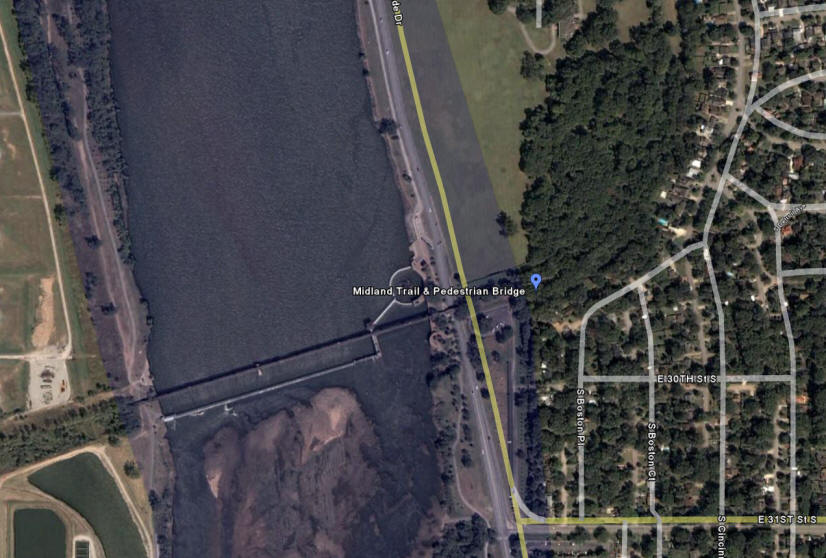
This path stretches from 21 St. S. between
Boston and Cincinnati Avenues west and south to the west end of the
pedestrian bridge over the Arkansas River. Extensions may be made at
each end, northward along the river on the west side and northward from
21 St. to 18 St. along the cleared but unpaved railroad right-of-way.
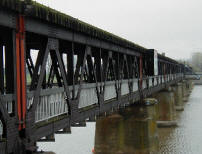 A parking lot is at Riverside Drive near
the eastern end of the pedestrian bridge. Cars may be parked here or on
26 St. where it crosses the pathway. Most people start at the pedestrian
bridge. The Arkansas River is over one-quarter mile wide and has been
dammed to make a shallow lake which extends several miles upstream.
Birding from the bridge varies with the seasons, the level of the lake,
and the flow of water. Mallards and Gadwalls may be seen in winter with
the aid of a scope. On a blustery November day in 1985 a Red-necked
Grebe was observed as it floated down river to the pedestrian bridge,
diving or flying upstream repeatedly. Many Ring-billed Gulls and a few
Herring Gulls use the sand flats in winter; Franklin's Gulls and Caspian
Terns in May and October; and Killdeer throughout the year. In May the
Least Terns nest on sand flats a mile or so downstream and with the use
of a scope the birder may see them flying to nests with food. A parking lot is at Riverside Drive near
the eastern end of the pedestrian bridge. Cars may be parked here or on
26 St. where it crosses the pathway. Most people start at the pedestrian
bridge. The Arkansas River is over one-quarter mile wide and has been
dammed to make a shallow lake which extends several miles upstream.
Birding from the bridge varies with the seasons, the level of the lake,
and the flow of water. Mallards and Gadwalls may be seen in winter with
the aid of a scope. On a blustery November day in 1985 a Red-necked
Grebe was observed as it floated down river to the pedestrian bridge,
diving or flying upstream repeatedly. Many Ring-billed Gulls and a few
Herring Gulls use the sand flats in winter; Franklin's Gulls and Caspian
Terns in May and October; and Killdeer throughout the year. In May the
Least Terns nest on sand flats a mile or so downstream and with the use
of a scope the birder may see them flying to nests with food.
In spring and summer Great Egrets, Snowy
Egrets and Great Blue Herons feed below the dam, while Green-backed
Herons catch frogs in shaded pools near the banks. Belted Kingfishers
are seen all year. Purple Martins, Barn and Rough-winged swallows are
common in season. When the water is low during migration shorebirds
appear, yellowlegs, Long-billed Dowitchers, Spotted and Solitary
sandpipers being most common. At the west end of the bridge Red-tailed
Hawks perch on the poles in winter and Scissor-tailed Flycatchers on the
wires in the summer. Watch the trumpet vines in late summer for
Ruby-throated Hummingbirds.
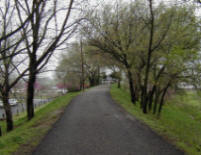 At the east end of the bridge the path
goes north and east past a meadow, original bottomland woods, and
hedgerows. The path is on an embankment part of the way as one walks
almost at tree-top level, a great vantage point for finding warblers,
vireos, and Rose-breasted Grosbeaks in spring. Later the path is in a
cut between embankments with underbrush and trees growing up the sides.
Bell's Vireos nest regularly in the brush on the north and House Wrens
on the south side near the entrance to the path from the parking lot. At the east end of the bridge the path
goes north and east past a meadow, original bottomland woods, and
hedgerows. The path is on an embankment part of the way as one walks
almost at tree-top level, a great vantage point for finding warblers,
vireos, and Rose-breasted Grosbeaks in spring. Later the path is in a
cut between embankments with underbrush and trees growing up the sides.
Bell's Vireos nest regularly in the brush on the north and House Wrens
on the south side near the entrance to the path from the parking lot.
 The woods to the north have a resident
flock of Bobwhites. With luck an Eastern Screech-Owl or a Great Horned
Owl may be found. Black-billed Cuckoos have been observed several times
and the thrush family is well represented according to season. Other
species are Red-eyed, White-eyed and Warbling vireos in summer; American
Redstart (possible June nester); Orange-crowned, Nashville, Yellow,
Yellow-rumped, and Yellow-throated warblers in migration; Indigo and
Painted buntings in summer; Brown Creeper, Ruby-crowned and
Golden-crowned Kinglet, Rufous-sided Towhee, Purple Finch and Pine
Siskin in winter, with six or seven species of sparrows in winter. The woods to the north have a resident
flock of Bobwhites. With luck an Eastern Screech-Owl or a Great Horned
Owl may be found. Black-billed Cuckoos have been observed several times
and the thrush family is well represented according to season. Other
species are Red-eyed, White-eyed and Warbling vireos in summer; American
Redstart (possible June nester); Orange-crowned, Nashville, Yellow,
Yellow-rumped, and Yellow-throated warblers in migration; Indigo and
Painted buntings in summer; Brown Creeper, Ruby-crowned and
Golden-crowned Kinglet, Rufous-sided Towhee, Purple Finch and Pine
Siskin in winter, with six or seven species of sparrows in winter.
See also the
River Parks account for more details on birding this section of the
Arkansas Rive. |